039 The Gothic Carved Sideboard: Helping Another Woodworker's Work Stand the Test of Time
Some woodworking projects begin with a pile of lumber and an idea. Others begin more than a century after the original woodworking has already been completed.
Our large carved sideboard falls into the second category.
I did not build it. I do not know exactly who did. In fact, that remains one of the mysteries surrounding this remarkable piece of furniture. But after spending a considerable amount of time repairing and stabilizing it, I have come to know some of the decisions made by the woodworker — or perhaps woodworkers — who created it.
And in a small way, more than a century later, we have now worked on the same piece.
A Monumental Piece of Furniture
The sideboard is roughly seven feet long, about seven feet tall and approximately thirty inches deep. It is not simply a cabinet decorated with a little carving. The carving is a major part of the structure and character of the piece.
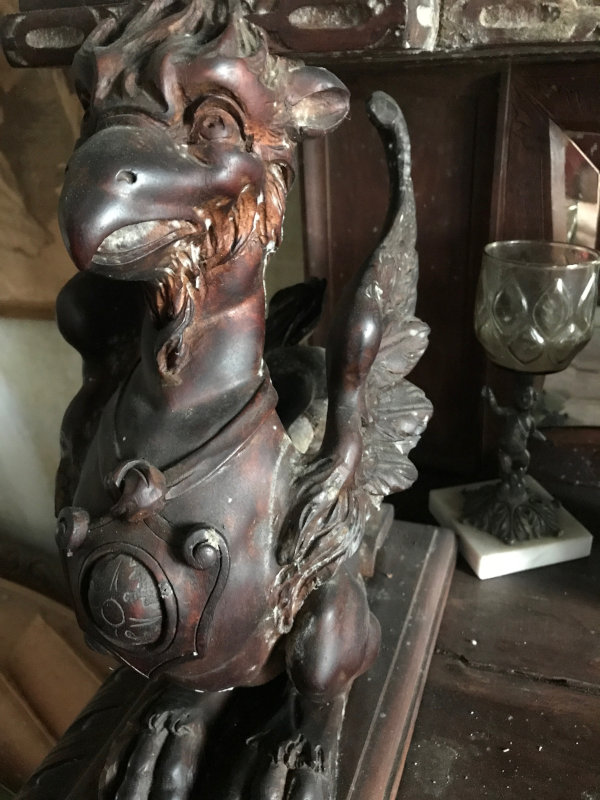
There are deeply carved mythical creatures, human figures, flowers, leaves, scrolls and architectural details throughout the sideboard. Some of the figures project far beyond the surrounding wood and actually become structural supports for shelves and other elements.
The upper section includes large mirrored areas with beveled glass. The overall effect is almost architectural. It was clearly meant to command attention in a large room.
Who Built It?
That is something we still do not know.
Over the years we have tried to learn more about the sideboard. Various possibilities have come up, including stories that it may have been connected with a religious or monastic community and perhaps made for someone of importance. We have also compared it with other elaborate European and American furniture from the late nineteenth century.
There are interesting clues, but at this point they remain clues rather than facts.
That is fine.
Part of preserving an old object is knowing the difference between what we know and what we suspect.
What we do know is that whoever built this piece had considerable woodworking and carving skill.
Perhaps More Than One Woodworker
When looking closely at a piece this complex, I sometimes wonder whether talking about “the woodworker” is too simple.
A sideboard of this size contains cabinetmaking, structural joinery, extensive carving, mirror work and numerous individual components. It may have been the work of one exceptionally talented craftsman, but it could just as easily have involved a master cabinetmaker working with apprentices, helpers or specialized carvers.
We may never know their names.
But their work is still here.
The Construction Tells a Story
One of my favorite things about old furniture is discovering how someone else solved a woodworking problem generations ago.
The drawers, for example, use large hand-cut dovetails. They are not the perfectly uniform dovetails we associate with modern machine production. They are functional, strong and clearly made as part of the original construction.
The doors are also interesting. Rather than being mounted with typical hinges, they operate on pivot points.
The door construction itself appears to use multiple layers and separate components rather than one massive slab of wood. That type of construction helps control one of the biggest challenges every woodworker faces: wood movement.
Wood expands and contracts as humidity changes. Good woodworking does not try to stop that movement. It allows the wood to move without destroying the piece.
Different Woods for Different Jobs
The primary visible wood is a fine, relatively closed-grained hardwood with some similarities to walnut, although we have never positively identified the species.
Inside the cabinet and in areas that were never intended to be seen, the original builders used lighter and softer secondary woods.
That is another reminder of thoughtful traditional cabinetmaking. Expensive or decorative wood could be reserved for the surfaces that mattered visually, while other woods performed structural jobs inside the furniture.
When the Structure Began to Fail
Unfortunately, surviving for generations does not mean surviving without problems.
Many years ago, the large upper portion of the sideboard actually fell. The failure caused several pieces to break, and the top was subsequently left off for a considerable period of time.
When I eventually began working on the sideboard, one of the biggest challenges was not cosmetic at all. It was figuring out how the major upper, middle and lower sections could once again function as one stable structure.
That became much of my work on the piece.
Hidden Repairs
Whenever possible, I wanted the repairs to strengthen the furniture without becoming part of its appearance.
I added a number of supports in areas where they cannot normally be seen.
One of the most important additions was a series of thin maple strips running vertically through strategically chosen hidden locations. These strips help connect the major sections of the sideboard together and greatly improve its stability.
The original builders did not install them.
I did.
But they were deliberately placed so that they do not compete visually with the original work.
A Modern Screw and an Old Drawer
One repair illustrates this philosophy particularly well.
A drawer front needed to be mechanically secured. I chose to use a screw because the repair needed reliable strength. Afterward, I plugged the screw location with wood so the modern fastener would not become a distracting feature on the front of the antique drawer.
It is a modern repair, and there is nothing wrong with acknowledging that.
The goal was never to pretend that I had somehow gone back in time and duplicated every original method.
The goal was to preserve the original piece.
Three or Four Hours for One Griffin's Toe
Some repairs were structural and involved large sections of the sideboard. Others came down to something as small as a single toe.
One of the carved griffins had originally been secured with a nail driven between its toes. At some point the wood split around the nail and one of the toes was lost.
I could have simply left it that way, but this was one of those little details that deserved another chance.
I selected a piece of black walnut and began carving a replacement. What sounds like a very small repair turned into three or four hours of careful carving, shaping and fitting before the new toe looked and fit the way I wanted it to.
There is something especially satisfying about that repair. More than a century ago, another woodworker carved the original griffin. I wasn't trying to replace that person's craftsmanship or make the carving new again. I was simply carving one small missing part so the original work could remain whole.
It may have taken several hours to replace something most people will never notice.
But perhaps that is exactly the point.
Preserving craftsmanship sometimes means spending hours on a detail that nobody will ever think about again — because when the repair is right, there is no reason for them to.
Repairing Without Erasing
There is an important distinction between restoration and making something look new.
I do not want this sideboard to look as though it came out of a furniture factory yesterday.
The old finish, small marks, variations in color and signs of age are part of its history.
My job was primarily structural. Loose areas needed support. Failed connections needed help. Broken components needed to be brought back together. The massive upper assembly needed to become stable again.
The original work should remain the star.
The Next Owner
There was another thought in the back of my mind while working on the sideboard.
The next owner may not be a woodworker.
They may love the piece just as much but not have the tools, experience or desire to crawl inside a large nineteenth-century cabinet and figure out why something is beginning to move.
That gives today's repair an additional responsibility.
If I can make the structure substantially more secure now, perhaps the next caretaker will only need to clean it, protect it and enjoy it.
Old Things Need Caretakers
I often think about old furniture in much the same way I think about a slate roof.
A good slate roof can last an extraordinarily long time.
But that does not mean nobody touches it for 150 years.
A slate may break. Flashing may eventually need attention. A fastener can fail. Someone notices a small problem and fixes it before that small problem becomes a major one.
The roof survives partly because it was well made.
It also survives because generations of people cared enough to maintain it.
Furniture is not very different.
Helping Each Other's Work Survive
One of the things I enjoy most about working on an old piece like this is the connection it creates between woodworkers who will never meet.
The people who built this sideboard could not have known me. They could not have known where their work would eventually end up or what would happen to it over the following century.
But they built something worth saving.
Eventually their work reached another woodworker who looked at it and decided it deserved some help.
We help each other's pieces stand the test of time.
Sometimes we build something new and hope another generation will appreciate it.
Other times we inherit the work of someone who came before us and become responsible for carrying it a little farther into the future.
Honoring the Original Woodworker(s)
I may never know the names of the woodworker or woodworkers who created this sideboard.
But after spending weeks inside their work — studying the joinery, dovetails, carvings, doors, wood movement and structural decisions — I feel a connection with them.
More than a century separates our work, but for a short period of time we worked on the same piece of furniture.
They created it.
My job was simply to help it keep going.
And if someone cares for it again when it eventually needs attention long after I am gone, then perhaps all of us — the original woodworker(s), myself and some future caretaker — will have helped the same piece of woodworking survive.
Watch the Sideboard Videos
We have documented some of the repair and preservation work on video. Additional video showing the complete sideboard and more of its construction will be added as we continue documenting the piece.
Watch the Gothic Carved Sideboard video playlist on YouTube
The exact age, maker and origin of this sideboard remain unknown. As we discover additional construction details or historical evidence, we will continue adding to its story.

Where the beauty of the wood does the work.
Brad Zehr | ZehrWoodartistry.com | brad@zehr.net