032 Functional Art: When an Old Tabletop Finds a New Purpose
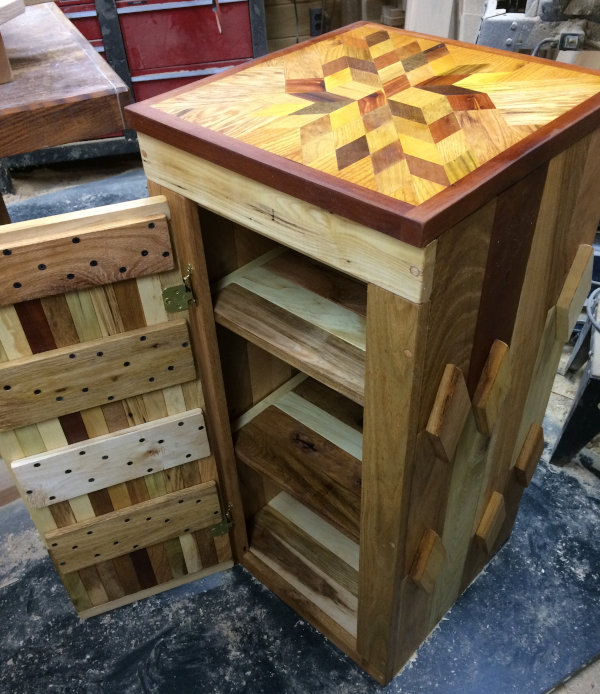
The artwork stayed—the function evolved.
Some woodworking projects remain exactly as they were first built.
Others continue to change with us.
About forty years ago, I made several wooden end tables. At the time, most of my attention went into creating the tops. I enjoyed combining different pieces of wood, arranging patterns, and building surfaces that would immediately draw the eye.
The legs were much simpler.
They worked well, supported the tables, and allowed the decorative tops to remain the focus. At that point in my woodworking journey, that was exactly what I wanted.
Years later, however, I looked at one of those tables and saw a different possibility.
The Most Valuable Part Was the Top
The original table still functioned, but the artistic top was the part that carried the greatest personality.
Its arrangement of contrasting woods had taken time, thought, and careful work. The simple base beneath it had always been secondary.
That realization led to a question:
Did the top need to remain an end table simply because that was how it began?
The answer was no.
The legs could be removed and reused elsewhere. Since the deck now had a roof over it, the old table base could continue serving a practical purpose there.
The decorative top, meanwhile, could become the beginning of something entirely new.
Separating the Art From Its Original Function
When furniture is built as one complete object, it is easy to think of every part as permanently connected.
But woodworking allows us to look at a piece differently.
A tabletop can become a cabinet top.
A door can become a wall panel.
A drawer front can become part of another design.
A strong artistic element does not necessarily belong to only one project for the rest of its life.
In this case, removing the original legs did not destroy the table. It revealed that the decorative top had enough visual strength to continue on its own.
The artwork stayed. The function evolved.
Building a New Purpose Beneath It
The new goal was to create a cabinet that could sit beside the bed and provide useful storage.
Instead of an open space beneath the top, the piece would now include:
- Interior shelves
- An enclosed storage area
- A hinged wooden door
- A stronger cabinet structure
- A useful surface beside the bed
The old tabletop established the size and personality of the new cabinet. Rather than designing the cabinet first and then searching for a top, the process worked in reverse.
The artwork became the starting point.
The cabinet was built to support it.
Letting the Old Work Guide the New
The new structure could have been plain, allowing the top to remain the only decorative element.
Instead, the cabinet continued the same spirit of experimentation.
Different wood species were mixed throughout the piece. Contrasting strips appeared inside the cabinet and on the door. The shelves carried their own changes in color and grain. Decorative wooden shapes were added to the sides, creating depth and connecting the cabinet visually with the geometric design above.
The top remained the focal point, but the rest of the piece no longer felt like a simple support beneath it.
The old and new work began to belong together.
A Record of Two Different Woodworkers
Although the same person created both stages of the project, they were separated by decades of experience.
The original end table reflected the woodworker I was about forty years ago.
At that time, I wanted to spend most of my effort on the top. The surface was where I explored design, contrast, and pattern. The legs were intentionally straightforward because their main job was to hold everything up.
The later cabinet reflected a different stage of my woodworking life.
I still wanted the piece to be artistic, but I was also thinking more about storage, structure, adaptability, and how every visible area could contribute to the whole design.
The finished cabinet therefore contains two periods of craftsmanship.
The top shows an earlier artistic direction.
The cabinet beneath it shows how that direction continued to develop.
What Is Functional Art?
Functional art exists somewhere between a practical object and a work created primarily for visual expression.
A bedside cabinet must perform real jobs. It needs to stand securely, hold objects, provide storage, and fit into the room where it will be used.
But usefulness does not require the piece to disappear into the background.
Functional art can:
- Solve an everyday problem
- Show the character of the materials
- Express the maker's ideas
- Invite closer observation
- Bring personality into an ordinary part of life
This cabinet works beside the bed, but it also tells a story every time it is seen.
That is what makes it functional art.
Reuse Can Be More Creative Than Replacement
When an old piece of furniture no longer fits our needs, the most obvious choices are often to store it, sell it, or discard it.
There is another option:
Keep the best part and design a new life around it.
This approach can preserve:
- Quality materials
- Earlier craftsmanship
- Personal history
- Unique design work
- The emotional connection to an older project
It can also produce something that would never have existed if the entire project had been started from new lumber and a blank plan.
The old piece brings history.
The new work brings opportunity.
The Value of Building for Change
This project also demonstrates one of wood's greatest strengths.
Wooden furniture can often be disassembled, cut apart, rebuilt, extended, reinforced, and adapted. A component made decades earlier can still become part of a new design.
That does not mean every project should be taken apart later. It means woodworking gives us options.
A piece does not always have to remain frozen in its original purpose.
As our homes, needs, and ideas change, our woodworking can change with them.
The Function Changed, but the Story Continued
The original table had a simple job.
It provided a surface and displayed a decorative top.
The later cabinet had a more complex role. It needed to provide a surface, create storage, organize items beside the bed, and become part of the room's design.
Yet the transformation did not erase the table's history.
The top still carries the marks of the earlier project. It still represents the time spent selecting, cutting, and arranging the individual pieces of wood.
The cabinet simply allowed that work to continue serving a useful purpose.
Final Thoughts
Woodworking is not always about starting over.
Sometimes it is about recognizing which part of an older project still has something important to offer.
The legs from the original table found another use.
The artistic top became the foundation of a new cabinet.
The cabinet gained storage, shelves, a door, and additional decorative details.
Nothing valuable had to be lost for the project to change.
That is one of the great possibilities of working with wood: an object can evolve without forgetting where it began.
The artwork stayed—the function evolved.
And in that transformation, an old end table became something more useful, more personal, and perhaps even more complete than the original.

Where the beauty of the wood does the work.
Brad Zehr | ZehrWoodartistry.com | brad@zehr.net