031 Inlay vs. Onlay: Two Ways to Add Beauty to Wood
One becomes part of the surface. The other gives the surface a new dimension.
Decorative woodworking often begins with a simple question:
Should the design be placed into the wood, or added onto it?
Those two approaches are known as inlay and onlay. The words sound similar, and both can be used to create patterns, contrast, texture, and visual interest. However, they describe two distinctly different ways of working.
Inlay is widely recognized as a traditional woodworking term. Onlay is also a legitimate term, although it may be less familiar to many modern woodworkers. It is sometimes described as an appliqué, applied ornament, or applied carving.
The easiest way to remember the difference is:
Inlay goes into the surface. Onlay goes onto the surface.
What Is Wood Inlay?
Inlay is created by cutting a recess into a base piece of wood and fitting another material into that opening. The inserted material is normally brought flush, or nearly flush, with the surrounding surface.
The inlaid material might be:
- A contrasting species of wood
- Wood veneer
- Metal
- Shell or mother-of-pearl
- Stone
- Colored resin
- Another decorative material
The defining feature is not the material itself. It is the fact that the decorative piece is fitted into a prepared recess in the original surface. :contentReference[oaicite:0]{index=0}
What Is Wood Onlay?
An onlay is a decorative piece that is attached to the face of an existing surface. Instead of cutting deeply into the base wood, the craftsperson makes or selects the decorative element and applies it on top.
An onlay may be:
- A carved ornament
- A geometric wooden shape
- A flower, leaf, or scroll design
- A decorative molding
- A raised medallion
- A layered pattern
- A piece of architectural trim
Onlays are often seen on cabinets, furniture, doors, mantels, wall panels, and Victorian-style architectural details. They may be glued, pinned, screwed, or attached through a combination of methods. :contentReference[oaicite:1]{index=1}
The Main Difference
The difference is determined primarily by where the decorative piece sits in relation to the original surface.
- Inlay: The base wood is recessed and the decorative material is inserted into it.
- Onlay: The decorative material is attached over the base wood.
An inlay usually becomes visually integrated with the surface. An onlay usually creates dimension, shadow lines, and relief.
Both can be elegant. Both can require considerable skill. They simply produce their effects in different ways.
Does Adding a Border Turn an Onlay Into an Inlay?
This is where the distinction becomes especially interesting.
Suppose a decorative wooden shape is attached directly to a flat surface. It begins as an onlay. The woodworker then adds a raised border or molding around it, bringing the surrounding design closer to the height of the decorative piece.
The final result may look as though the central design has been set into the wood.
However, it would generally still be considered an onlay because the central piece was attached to the original surface rather than inserted into a recess.
The border changes the visual relationship, but it does not necessarily change the original construction method.
Depending on the design, the finished work might also be described as:
- An applied panel
- A framed onlay
- A raised panel design
- An applied ornament surrounded by molding
This is a good example of how the order of construction can influence the terminology, even when two finished pieces appear very similar.
Construction Method Versus Final Appearance
Imagine two nearly identical designs.
For the first, the woodworker cuts a shallow pocket into a tabletop and fits a contrasting diamond into it. Once sanded, the diamond is flush with the table. That is an inlay.
For the second, the woodworker glues the same diamond onto the tabletop and then builds a border around it. The border may make the diamond appear enclosed or embedded, but it remains an applied element. That is better described as an onlay or applied design.
From across the room, the two pieces might look surprisingly similar.
From the woodworker's perspective, however, they were created through different sequences, required different decisions, and presented different challenges.
Advantages of Inlay
Inlay can create an exceptionally refined and integrated appearance.
Its advantages include:
- A smooth, nearly uninterrupted surface
- Protection for the decorative material
- The ability to create precise lines and patterns
- A traditional fine-furniture appearance
- Little interference with the use of a tabletop or writing surface
Because the recess must closely match the inserted piece, inlay often demands careful layout, controlled cutting, and precise fitting.
A small gap may be visible immediately, especially when contrasting woods are used. The process can be slow, but the finished effect can be subtle and beautiful.
Advantages of Onlay
Onlay offers a different kind of freedom.
Its advantages include:
- It can be added to an existing project.
- It does not require removing as much material from the base.
- It can create depth and strong shadow lines.
- It works well with architectural and Victorian-inspired designs.
- Individual pieces can sometimes be replaced or changed later.
- It allows several layers to be built into one composition.
Onlay is especially useful when transforming something that has already been built. A plain cabinet door, wall panel, chest, or shed can gain an entirely new personality through applied wooden elements.
The surface becomes a kind of canvas.
A Simple Box Becomes a Canvas
One practical example of onlay began with an old wooden gun-cleaning kit. Although I no longer hunt, I liked the box and thought it was worth preserving.
The original plan was simple: lightly sand the surface and apply oil to refresh the appearance—to make the wood happy again.
While working on it, another thought occurred:
Why not add a design to the top?
Six individual pieces of contrasting wood were shaped, beveled, arranged into a star-like pattern, and attached directly to the lid. Because the pieces sit above the original wooden surface rather than being fitted into recesses, the design is an onlay.
The raised pieces create depth, edge shadows, and a strong contrast between the lighter ornament and the darker box. The original object remains recognizable, but the added design gives it a new personality.
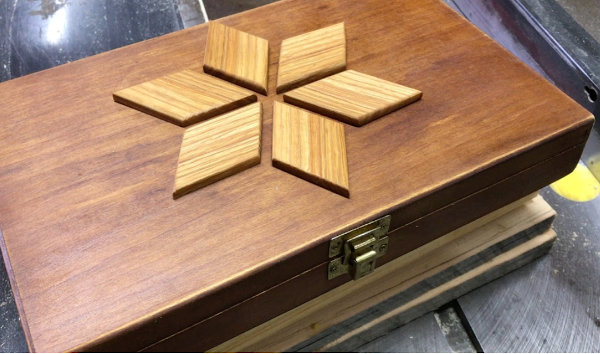
This also demonstrates one of the great advantages of onlay: the main project can already be complete. A plain surface can become a canvas whenever a new idea appears.
Onlay Is Not Merely the Easier Version
It may be tempting to think that inlay is the advanced technique and onlay is simply the easy alternative. That would underestimate what can be accomplished with applied work.
A well-made onlay must still be designed carefully. The thickness, proportion, grain direction, edge treatment, spacing, fastening method, and relationship to surrounding moldings all matter.
Raised decorative work also creates shadows, which means even a small variation in shape or alignment may become more noticeable.
The challenge is different, but the opportunity for craftsmanship is just as real.
Onlay in Architectural Woodworking
Onlay is particularly well suited to architectural woodworking because it can be added after the main structure is complete.
Examples include:
- Decorative diamonds on exterior walls
- Scalloped trim beneath roof edges
- Applied brackets and braces
- Carved ornaments on doors
- Raised patterns on cabinets
- Decorative corner blocks
- Layered trim around windows
This is one reason wood buildings can continue to evolve. Their surfaces can accept new details years after the original construction.
The building does not need to be torn apart to gain a new design language.
Inlay in Fine Furniture
Inlay is often associated with writing desks, tables, boxes, musical instruments, cabinets, and other pieces meant to be viewed closely.
A narrow contrasting line around the edge of a tabletop can visually frame the entire piece. A small floral design can become a focal point. A bowtie-shaped inlay may be both decorative and structural, helping stabilize a split in a slab.
Because inlay becomes part of the surface, it can create visual complexity without adding physical bulk.
What the Two Methods Have in Common
Although inlay and onlay are technically different, they share many of the same artistic decisions.
The woodworker must still consider:
- Color contrast
- Wood grain
- Scale
- Symmetry or asymmetry
- Placement
- Repetition
- How the design relates to the whole piece
Technique determines how the ornament is installed.
The artistic eye determines whether it belongs there.
Technique and the Artistic Eye
Some craftspeople have an extraordinary ability to reproduce a design exactly. They can study an original piece, understand its construction, and make another so accurately that it is difficult to see a difference.
That is a remarkable skill.
Other craftspeople begin with a plan but soon see another possibility. A different curve, another layer, a revised proportion, or an unexpected arrangement begins to feel more interesting than the original design.
Neither approach is inherently better.
One preserves and perfects an established idea.
The other allows the idea to evolve.
The strongest work may sometimes require both: enough technique to make the piece well, and enough artistic vision to recognize when the plan should change.
Choosing Between Inlay and Onlay
Inlay may be the better choice when:
- The surface needs to remain flat.
- The decoration should appear integrated into the base wood.
- The project calls for subtle contrast.
- The piece will receive frequent contact or use.
- The design depends on precise lines and close fitting.
Onlay may be the better choice when:
- The design should have visible depth.
- The ornament is being added to an existing project.
- The surface should cast interesting shadows.
- The style is architectural, carved, layered, or Victorian-inspired.
- The design may continue to evolve during construction.
Sometimes the project itself will suggest the answer.
Can Inlay and Onlay Be Used Together?
Absolutely.
A piece might include a flush inlaid border surrounding a raised central onlay. An applied panel might contain smaller inlaid details. A cabinet door could combine recessed contrasting wood with raised carved ornaments.
Once the differences are understood, the two techniques do not need to compete.
They can strengthen one another.
Final Thoughts
Inlay and onlay are two different routes to the same larger goal: giving wood another level of expression.
Inlay places the design into the surface.
Onlay builds the design onto the surface.
Adding a border around an onlay may make it appear visually embedded, but the method usually remains an applied or onlaid construction. The order of the work matters because it tells us how the design was actually created.
Yet terminology is only one part of the story.
The more important question is whether the decoration strengthens the project.
Does it add balance?
Does it create contrast?
Does it make the piece feel more complete?
Technique makes the work possible, but the artistic eye decides where the work can go next.

Where the beauty of the wood does the work.
Brad Zehr | ZehrWoodartistry.com | brad@zehr.net