030 A Shed Worth Saving: How Small Projects Teach Big Lessons
Beauty can grow out of solving problems.
Not every woodworking project begins with a grand design. Sometimes the original goal is simply to build something useful, get it working, and move on to the next job.
Years ago, I needed a small shed for lawn equipment, garden tools, and other outdoor items. I built a basic structure about five feet by seven feet and placed it partly in the woods. It rested on treated 4x4s supported by a few stones, had a simple homemade door, and included only a modest roof overhang.
It wasn't fancy, but it served its purpose.
Time Reveals What a Building Needs
As the years passed, the shed began to reveal the weaknesses in its original design.
The rough wooden door did not close tightly, which made the shed especially inviting to mice. They repeatedly found their way inside and made a mess among the stored tools and equipment.
Eventually, I replaced the original door with a regular exterior house door. It fit more securely, closed tightly, and did a much better job of keeping the mice out.
That solved one problem, but another was developing along the back of the building.
Because the original roof had very little overhang, rainwater regularly reached the wooden siding. Over time, the lower portion of the back wall began to rot. Once the wood deteriorated, the new openings again made it easier for mice to enter.
Nature has a way of showing us where a design can be improved.
Repairing Instead of Replacing
It would have been easy to look at the aging shed and decide to tear it down. After all, it was small, simple, and originally built only as a utility structure.
But most of the shed was still sound.
The basic wooden frame remained useful, and wood construction made it possible to repair, reshape, and expand the original design. Instead of replacing the entire building, I could concentrate on the areas that needed attention.
The damaged sections were repaired, the roof was extended to create better protection, and splash guards were added near the bottom of the walls. These changes addressed the causes of the deterioration rather than simply covering the visible damage.
Good repairs do more than restore what was there. They improve the design so the same problem is less likely to return.
When a Repair Becomes a Redesign
After working on Zehr Estate for several years, we decided to give Zehr Escape a makeover using some of the same colors and architectural ideas.
The little shed became the first building we transformed.
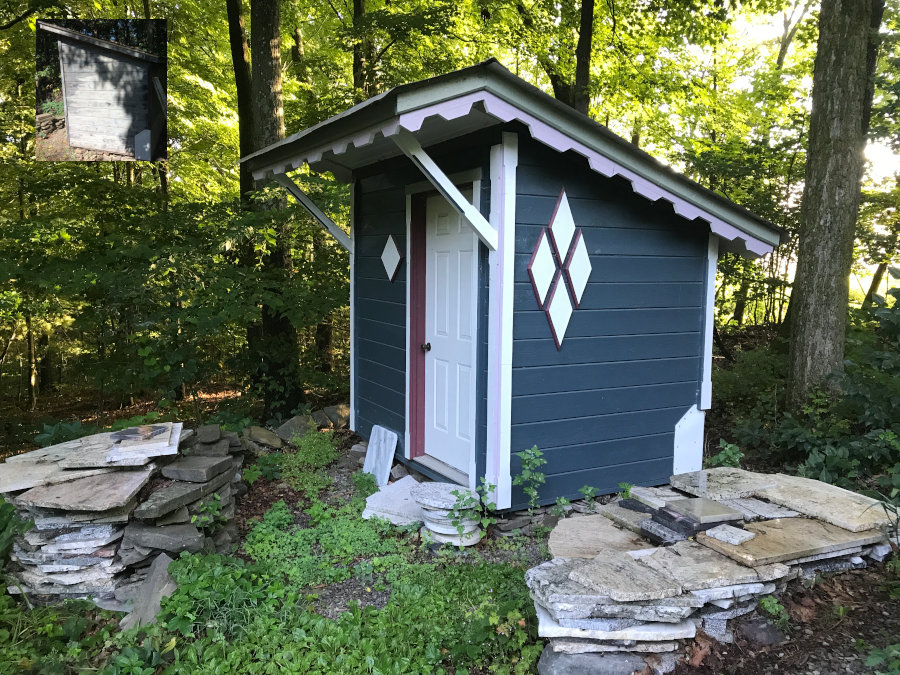
What began as a practical repair gradually became an opportunity to give the shed an entirely new personality. We added decorative trim, extended roof details, braces, scalloped elements, contrasting colors, and diamond-shaped wall decorations.
The exterior house door that had originally been installed to solve the mouse problem now fit naturally into the upgraded design.
The dark siding, light trim, and deep red accents connected the shed visually with the larger buildings and projects on the property. A structure that had once blended quietly into the woods began to look intentional.
Wood Welcomes Change
One of the great advantages of building with wood is its adaptability.
A wooden structure can be repaired one board at a time. Trim can be added years after the original construction. Rooflines can be extended. Brackets, moldings, splash guards, and decorative pieces can be shaped to fit what is already there.
The original shed did not need to be perfect in order to become something special later.
Its simple construction actually gave us the freedom to experiment. We could stand back, look at the proportions, add a piece, adjust the design, and allow the building to develop gradually.
Practical Improvements Can Also Be Beautiful
Nearly every major change began with a practical need.
- The exterior door was added to keep mice out.
- The roof was extended to move water farther away from the siding.
- The damaged wood was repaired to protect the structure.
- Splash guards were added to reduce future moisture damage.
- Trim and decorative elements helped unite the shed with the rest of the property.
Function and beauty did not compete with each other. The practical improvements created the opportunity for the visual transformation.
That is an important woodworking lesson: solving a problem does not have to result in something plain. A repair can become a design feature, and a limitation can become the beginning of a more creative solution.
Learning From the Original Build
The shed also became a reminder of how much we learn by looking back at earlier projects.
When I first built it, the small overhang seemed sufficient. Years of weather showed otherwise. The loose-fitting door was quick and economical, but it created an ongoing pest problem.
Those were not failures. They were lessons.
The experience reinforced the importance of generous roof overhangs, water management, tight-fitting doors, and protecting vulnerable areas near the bottom of an exterior wall.
Lessons learned from one small shed can influence much larger projects later.
A Small Building With a New Purpose
The shed still performs the same basic job it was built to do. It holds lawn equipment, tools, and outdoor supplies.
But now it does something more.
It contributes to the character of the property. It reflects ideas developed while restoring and redesigning other buildings. It shows how a plain utility structure can be given craftsmanship, personality, and a sense of belonging.
It also proves that a project does not need to be large to inspire creativity.
Final Thoughts
Sometimes woodworking means building something new from carefully prepared plans.
Other times, it means standing in front of an old shed and seeing more than worn siding, a short roof, and places where mice have found their way inside.
It means recognizing that the structure still has value.
It means solving one problem, noticing another opportunity, and gradually allowing a practical repair to become a creative transformation.
The little shed began as a basic place to store yard equipment. Years later, it became one of the first buildings to carry the evolving design of Zehr Escape.
Beauty can grow out of solving problems.
Sometimes all a project needs is another look, a few thoughtful improvements, and someone willing to imagine what it could become.

Where the beauty of the wood does the work.
Brad Zehr | ZehrWoodartistry.com | brad@zehr.net