028 The Beauty of Asymmetry: When a Mistake Fits the Hand Better
How a Random Solution to a Crooked Handle Became My Favorite Design
Sometimes a project is only seconds away from becoming firewood when the right idea arrives.
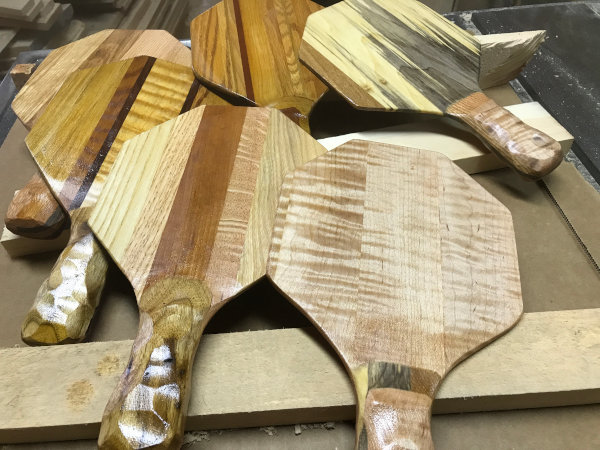
A few years ago, I was making wooden ping-pong paddles. I had already completed a couple, and they had turned out very well. The wood felt good, the shapes looked right, and I was pleased with the results.
Then I ran into a problem.
When the Handle Slipped
While gluing one of the handles, one side moved slightly out of position.
Glue can make wood surprisingly slippery. If the clamps are tightened too quickly, the pieces may slide before the pressure holds them firmly in place.
That is exactly what happened.
Once the glue had dried, the handle was clearly off. One side no longer aligned properly with the other.
I tried to reshape it and make it look right, but the more I worked on it, the more obvious the problem became.
The paddle was crooked.
Eventually, I decided it was not worth saving.
One Step Away from the Fire
I walked over to the woodstove, opened the door, and placed the paddle on top of the wood that was already burning.
Then I closed the door.
For a moment, that was the end of the paddle.
But almost immediately, a thought came to mind:
Make it random.
I quickly opened the stove, reached in, and pulled the paddle back out.
It had been only moments away from becoming fuel.
From Crooked to Intentional
I carried the paddle over to the belt sander.
Instead of continuing to fight the crooked handle and trying to force it back into perfect symmetry, I began sanding random bevels into it.
I changed the angles.
I softened some areas more than others.
I let the shape become irregular on purpose.
The mistake slowly disappeared—not because the handle had become symmetrical again, but because the entire design now looked intentional.
The crookedness was no longer the feature that caught the eye.
The sculpted form was.
The Hand Became the Judge
Visually, the new handle looked much better.
But the real surprise came when I used it.
After testing all the wooden paddles, the rescued paddle became my favorite by a wide margin.
The random bevels created a handle that felt remarkably comfortable. The irregular surfaces gave my fingers and palm natural resting points. The paddle felt secure, responsive, and easy to control.
What had looked like a failed handle turned out to fit the hand better than the carefully symmetrical ones.
From that point forward, I began shaping all the paddle handles in a similar way.
Symmetry, Randomness, and Balance
Perfect symmetry can be beautiful.
It creates order, formality, and predictability.
But symmetry is not the only path to a successful design.
There is also randomness, where elements have no meaningful relationship to one another.
And then there is something between the two:
balanced asymmetry.
In balanced asymmetry, the two sides do not match exactly, yet the whole still feels complete.
The design has movement without feeling chaotic.
It has variety without losing control.
It may be uneven, but it is not unbalanced.
Nature Rarely Matches Perfectly
Nature gives us examples of balanced asymmetry everywhere.
A tree may have more branches on one side than the other, yet it still appears stable and beautiful.
A stone may have no matching edges, but its shape feels complete.
Wood grain flows differently through every board. Knots, mineral streaks, spalting, and color variations rarely appear in mirrored patterns.
Much of what we find beautiful in natural materials comes from variation rather than repetition.
The challenge is not to make every part match.
The challenge is to make every part belong.
When Function Reveals the Better Design
The paddle also taught me that our eyes are not always the best judges of a design.
At first, I judged the handle by appearance.
It looked crooked, so I considered it a failure.
After reshaping it, my hand became the judge.
My hand did not care whether the bevels matched.
It cared about comfort, grip, control, and confidence.
Sometimes we spend so much time trying to make something look perfect that we forget to ask how it actually feels or works.
Controlled Irregularity
There is an important difference between carelessness and intentional asymmetry.
The random bevels were not left rough or unfinished.
They were shaped, tested, adjusted, and refined.
The pattern was irregular, but the craftsmanship still mattered.
That may be the real secret of balanced asymmetry:
freedom within control.
The form does not need to be mathematically perfect, but it still needs proportion, comfort, purpose, and balance.
A Design Personality
Looking back, I realize that some of my favorite woodworking and architectural details are asymmetrical.
I like pieces that have movement.
I like grain that changes direction.
I like designs that feel natural rather than mechanically repeated.
Perhaps that is simply part of my design personality.
But I also think asymmetry works especially well with wood because wood itself is never truly uniform.
Every board brings its own character.
A good design does not always force that character into perfect repetition. Sometimes it allows the irregularity to become part of the beauty.
Before You Throw It Away
The paddle taught me a lesson I have carried into many other projects.
When something goes wrong, the first solution may be to repair it.
The second may be to hide it.
But there is sometimes a third possibility:
change the design.
Before putting a failed piece into the stove, scrap pile, or trash, it may be worth pausing for one more moment.
Ask whether the mistake could be exaggerated, repeated, reshaped, or turned into something intentional.
The flaw may not be the end of the design.
It may be the beginning of the better one.
Wood Artistry Lesson: Perfect symmetry is not always the highest goal. Sometimes a small irregularity creates better balance, greater comfort, and improved performance. The crooked handle I nearly burned became my favorite because I stopped trying to make it match and started trying to make it belong.

Where the beauty of the wood does the work.
Brad Zehr | ZehrWoodartistry.com | brad@zehr.net