014 The Temporary Staircase That Became Permanent
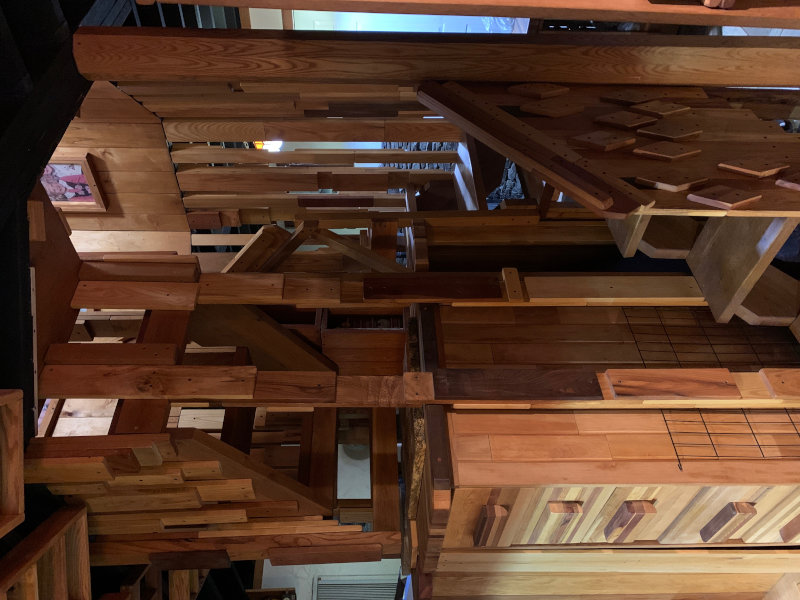
After we moved into our home, there was still a great deal of work left to do.
I had already exceeded the original construction budget by roughly two times, so every new part of the project had to be approached carefully.
One of the things we still needed was a staircase.
I had studied the plans for a wooden spiral staircase, and they were challenging, but I had worked through them and understood how the structure needed to come together.
My original plan was practical.
I would build a temporary staircase so we could use the upper level safely. Later, when I had more time, more money, and properly dried lumber, I would replace it with the beautiful permanent staircase I really wanted.
To save money, I decided to use rough-cut red oak straight from the sawmill.
It was strong, available, and affordable.
It was also very wet.
Too Much Work to Be Temporary
I began cutting, fitting, and building the staircase with the understanding that it would eventually be replaced.
But as the work progressed, a thought occurred to me.
This is far too much work to be temporary.
A spiral staircase is not a simple set of steps.
Each part depends on the others. The rise, rotation, tread position, support, clearances, and connections all have to work together.
I had already invested a great deal of thought and labor into the structure.
The more I built, the less sense it made to treat it as disposable.
Instead of continuing immediately, I slept on it.
By the next day, I had a different plan.
Working With Green Red Oak
The red oak had come directly from the sawmill and had not been kiln-dried or air-dried for an extended period.
It was so wet that water would sometimes come from the planer as I worked the boards.
That created a significant challenge.
As green wood dries, it shrinks. Depending on the grain direction and the way moisture leaves the board, it may also warp, cup, twist, check, or split.
Oak can be especially difficult when it dries too quickly.
I knew the staircase would be only about five feet from our wood stove.
That stove has heated our home for around forty years, and the heat naturally rises through the stair area to the upper floor.
The staircase would therefore be exposed to a warm, dry environment that could pull moisture from the green oak rapidly.
Rapid drying was the real danger.
The Goal Was Not to Stop Drying
The wood had to dry eventually.
There was no practical way to keep freshly cut oak at its original moisture level, nor would that have been desirable.
The goal was not to stop the drying.
The goal was to slow it down.
Wood tends to develop more severe drying defects when moisture leaves too quickly or unevenly.
If the surface dries and shrinks while the center remains very wet, stresses can build inside the board. Those stresses may lead to cracking, checking, distortion, or movement.
A slower, more gradual moisture change gives the wood more opportunity to adjust.
Using Linseed Oil to Slow Moisture Loss
My plan was to plane each component and apply linseed oil as quickly as possible after the piece was ready.
I used multiple coats.
The oil did not make the wood permanently waterproof, and it did not prevent the oak from drying.
Instead, it helped slow moisture exchange at the exposed surfaces.
That was exactly what I wanted.
Rather than allowing the heat from the wood stove to pull moisture rapidly from bare, freshly planed oak, the finish gave the lumber a more gradual transition.
Each piece could continue drying over time, but not as abruptly.
It was a practical solution based on understanding what the wood needed rather than trying to force it to behave like dry lumber.
Designing for Shrinkage
The staircase was assembled while the oak still contained a great deal of moisture.
I knew the pieces would shrink as they dried.
The important question was whether that shrinkage would damage the structure.
Because of the way the staircase was constructed, the expected movement could occur without compromising its function.
The individual pieces were relatively short, and they were connected within a larger framework. Their grain directions, fastening points, and positions helped distribute the changes throughout the structure.
The staircase did not depend on one wide board remaining perfectly unchanged.
Instead, it was made from many interconnected components that could each move a small amount as the oak dried.
The design allowed the wood to shrink without causing the staircase to fail.
That did not mean movement was impossible.
It meant the movement had been considered.
Wood Movement Is Not Always a Defect
Woodworkers often speak about movement as though it is something that must be eliminated.
In reality, movement is part of working with wood.
Wood absorbs and releases moisture throughout its life.
It changes with humidity, temperature, airflow, and season.
A successful project does not always prevent movement.
Often, it allows movement to happen safely.
That distinction became especially important with this staircase.
I was not expecting the green oak to remain exactly the size it was when it came from the sawmill.
I was expecting it to change.
The goal was to make sure those changes did not weaken the stairs, loosen critical connections, or distort the structure beyond use.
The Result
The plan worked.
The red oak dried gradually in place.
Very little cracking occurred, and there was surprisingly little movement in the lumber.
The staircase remained strong and usable.
What had begun as a temporary solution no longer felt temporary.
The structure had proven itself.
Instead of tearing it out and starting again, I continued developing it.
Letting the Project Grow Over Time
Years later, I added more design around the staircase.
I strengthened areas where additional support made sense.
I added surrounding woodwork, railings, vertical elements, and decorative details that made the staircase safer and visually more complete.
The final result did not appear all at once.
It grew in stages.
The original practical structure became the foundation for the artistic staircase I had hoped to build someday.
In the end, I did create the permanent staircase.
I simply created it over time rather than all at once.
Temporary Does Not Have to Mean Disposable
We often think of temporary construction as something crude, inexpensive, and destined for removal.
Sometimes that is appropriate.
But temporary can also mean a first stage.
A project may begin with the materials and resources available at the moment, then improve as time, experience, and opportunity allow.
The important thing is to build the first stage thoughtfully enough that it can support future development.
Had I built the staircase carelessly because I expected to replace it, none of the later design work would have mattered.
Because I treated the temporary version seriously, it was able to become permanent.
Necessity Can Improve the Design
The limited budget initially felt like a restriction.
I could not simply order expensive dried lumber and build the final staircase immediately.
But that limitation forced me to think more deeply.
I had to understand the wood.
I had to consider how it would dry.
I had to think about the nearby stove, the structure, the fastening, the shrinkage, and the future of the project.
The lack of ideal conditions led to a more interesting solution.
Instead of merely following a plan, I had to adapt the plan to the materials and circumstances in front of me.
That is often where creativity begins.
Lessons From Green Wood
Building with green wood requires respect for the material.
Freshly sawn lumber is not simply dry lumber that happens to feel damp.
It behaves differently.
It cuts differently.
It planes differently.
It changes dimension as it dries.
It responds strongly to heat and airflow.
A builder must consider where the moisture will leave, how quickly it will leave, and what the resulting shrinkage may do to the project.
Those challenges do not always make green wood unusable.
They mean the project must be designed with those realities in mind.
Knowing When to Change the Plan
Another important lesson came from recognizing that the original plan was no longer the best plan.
I began with the intention of building something temporary.
Then the amount of work, the quality of the material, and the emerging structure caused me to reconsider.
It would have been easy to continue simply because that was the original decision.
Instead, I stopped and thought.
Sleeping on the problem gave me enough distance to see another possibility.
Good craftsmanship is not only about following plans accurately.
It is also about recognizing when the project is telling you that the plan should change.
A Staircase Built in Chapters
When I look at the staircase today, I do not see one project.
I see several chapters.
I see the need for a safe way upstairs.
I see a limited budget.
I see rough-cut red oak coming directly from the sawmill.
I see water coming from the planer.
I see the concern about drying beside the wood stove.
I see the decision to use linseed oil and slow the process.
I see the structure settling and proving itself over time.
I see the later additions that made it safer, stronger, and more artistic.
Each stage became part of the final result.
Final Thoughts
The staircase began as a compromise.
I did not have the budget, the dry lumber, or the time to build the finished version I imagined.
What I did have was rough-cut red oak, a working plan, and the willingness to solve each problem as it appeared.
Once I realized the staircase was too much work to be temporary, I stopped treating it as something that would eventually be discarded.
I began thinking about how it could survive.
Slowing the drying was the key.
Designing the structure so shrinkage could occur safely was equally important.
Then time did the rest.
Years later, the temporary staircase became the permanent staircase I had wanted from the beginning.
It just took a different path to get there.
Sometimes the finished project is not created in one perfect moment.
Sometimes it begins with necessity, grows through problem-solving, and becomes beautiful one thoughtful improvement at a time.

Where the beauty of the wood does the work.
Brad Zehr | ZehrWoodartistry.com | brad@zehr.net